Best Developmental Toys for Infants Unveiled
- 1.
Wait—Do Babies Even “Play” at 3 Months?
- 2.
What Toys Should a 3 Month Old Baby Have? The Holy Trinity of Simplicity
- 3.
What to Do for 3 Month Old Development? Spoiler: It’s You, Not the Toy
- 4.
How to Mentally Stimulate a 3 Month Old Baby Without Losing Your Mind
- 5.
How to Keep a 3 Month Old Baby Entertained? Hint: Less Is More
- 6.
Why Open-Ended > Electronic (Every. Single. Time.)
- 7.
Safety First: What to Avoid When Buying Developmental Toys for Infants
- 8.
Price vs. Value: Do You Really Need to Spend Big?
- 9.
How to Spot a “Developmental” Toy That’s Just Marketing Fluff
- 10.
Where to Find the Best Developmental Toys for Infants Without the Headache
Table of Contents
best developmental toys for infants
Wait—Do Babies Even “Play” at 3 Months?
Ever caught your 3-month-old starin’ at a ceiling fan like it’s the main character in their origin story? Or cooing at their own toes like they just discovered alien life? That ain’t zoning out—that’s *deep work*. At this stage, “play” looks less like stacking blocks and more like wide-eyed wonder, swattin’ at dangly things, and droolin’ on everything within reach. So when we talk about the best developmental toys for infants, we’re really talkin’ about gentle invitations to explore—not flashy distractions. Think high-contrast cards, soft crinkle squares, or a mirror that reflects their ever-evolving grin. Keep it simple, keep it safe, and for Pete’s sake—skip the battery-powered circus. Their brain’s already runnin’ a marathon just tryna figure out why your voice sounds like warm milk.
What Toys Should a 3 Month Old Baby Have? The Holy Trinity of Simplicity
Alright, let’s cut through the noise. A 3-month-old don’t need a toy chest full of plastic junk. They need three things: contrast, texture, and interaction. That’s why the best developmental toys for infants at this age include:
- High-contrast visual cards or books: Black-and-white patterns pop in their still-developing vision.
- Soft crinkle toys or textured teethers: Engage touch + hearing without overstimulatin’.
- Unbreakable baby-safe mirror: Boosts self-recognition and social smiling.
What to Do for 3 Month Old Development? Spoiler: It’s You, Not the Toy
Here’s the real tea: the most powerful best developmental toys for infants ain’t even a toy—it’s your face. At 3 months, babies thrive on responsive interaction. Narrate your coffee run (“Mama’s pourin’ beans!”). Mimic their babbles. Play peek-a-boo with a burp cloth. This back-and-forth builds language pathways faster than any $40 “smart” rattle. Research from Zero to Three shows that emotional attunement—eye contact, shared joy, mirrored expressions—is the bedrock of cognitive growth. So put the phone down, get on the floor, and let your goofy grin do the heavy lifting. Real development happens in the messy, unplugged moments between naps.
How to Mentally Stimulate a 3 Month Old Baby Without Losing Your Mind
Stimulatin’ a 3-month-old don’t mean flashcards or phonics—it means sensory variety with boundaries. Rotate a few key best developmental toys for infants weekly: one day it’s a red-black card, next day it’s a feathery lovey. Hang a mobile with slow-moving shapes (not spinning chaos). During tummy time, place a soft mirror just outta reach to motivate liftin’. And always follow their cues: if they turn away or fuss, they’re done. Overstimulation = meltdown city. Keep sessions short (3–5 minutes), calm, and always supervised. Remember: stimulation isn’t volume—it’s clarity. One clear contrast beats ten blinking lights.
How to Keep a 3 Month Old Baby Entertained? Hint: Less Is More
Entertainin’ a 3-month-old ain’t about constant action—it’s about presence + pause. Babies this age cycle through alert, drowsy, and fussy states fast. So instead of bombardin’ ‘em with toys, offer one simple best developmental toy for infants and watch what they do. Maybe they’ll stare at the black zigzag for two minutes. Maybe they’ll bat at a crinkle square once and yawn. That’s okay! Boredom isn’t failure—it’s space for their brain to integrate. Pro tip: wear ‘em in a carrier while you fold laundry. Your heartbeat, voice, and movement are entertainment enough. Save the toy rotation for alert windows, and never force play. Respect the veto. 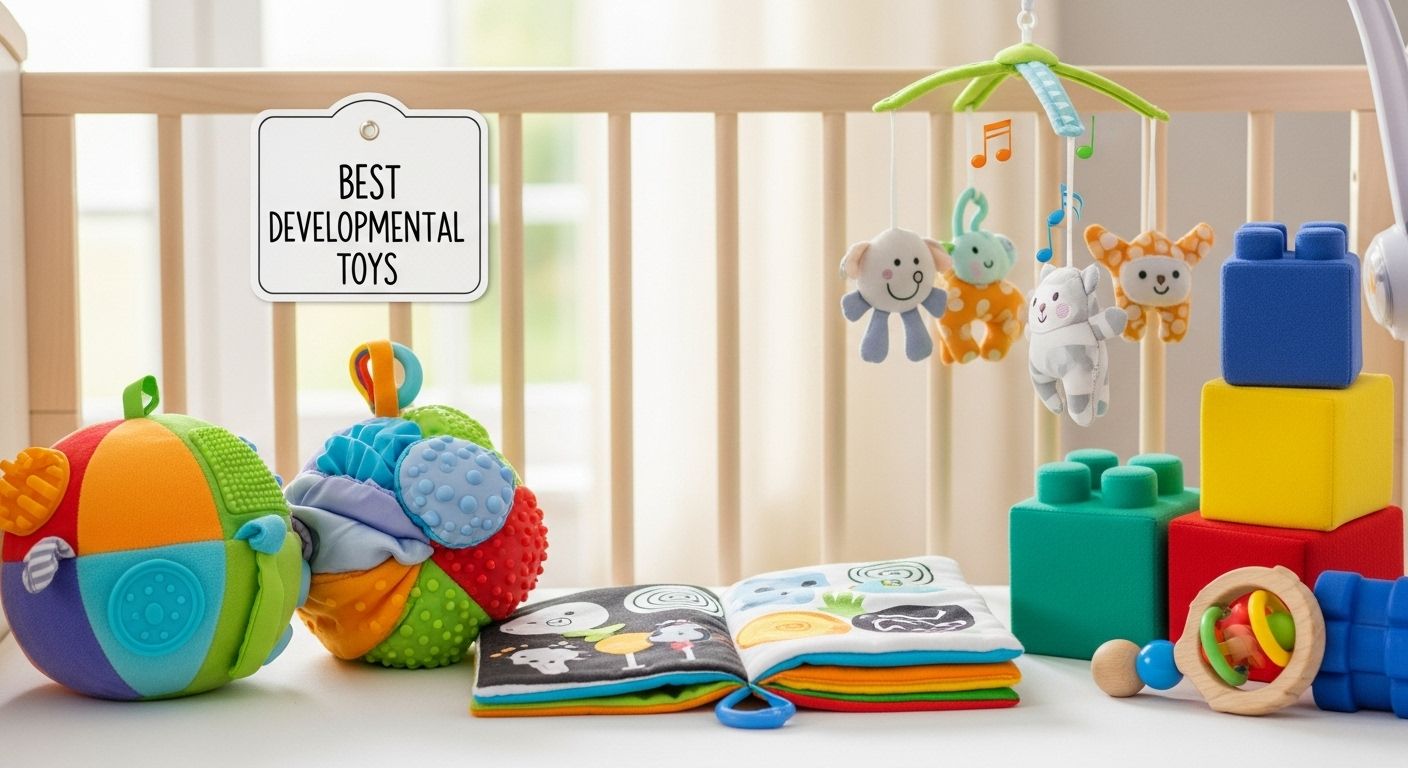
Why Open-Ended > Electronic (Every. Single. Time.)
That musical giraffe that sings lullabies in three languages? Yeah, it’ll collect dust by week two. But a plain cotton teether with nubby textures? Endless possibilities. Open-ended best developmental toys for infants—like crinkle fabric, soft rings, or high-contrast cards—invite exploration instead of dictatin’ play. No “right” way to use ‘em means baby leads the adventure. Plus, they’re quieter, safer, and won’t need a firmware update. A study from the University of Toledo found kids engage longer with simple toys because they’re not passive consumers—they’re co-creators. So skip the noise. Embrace the quiet rustle of a crinkle square or the soft thud of a teether droppin’. Real learning sounds like curiosity, not commercials.
Safety First: What to Avoid When Buying Developmental Toys for Infants
At 3 months, everything goes in the mouth—including your sanity. So when choosin’ best developmental toys for infants, safety’s non-negotiable. Avoid:
- Toys with small parts (if it fits through a toilet paper tube, it’s a choke hazard)
- Batteries that aren’t sealed shut
- Paints or plastics with BPA, phthalates, or mystery chemicals
- Strong artificial scents (if it smells like a lab, bin it)
Price vs. Value: Do You Really Need to Spend Big?
Here’s the truth: the best best developmental toys for infants don’t cost a fortune. Some of our faves? Under $12. A set of high-contrast cards ($8), a soft crinkle square ($10), or a DIY mirror (just tape a baby-safe mirror to cardboard). Thrift stores often carry gently used cloth books that’ve stood the test of time—and drool. And don’t underestimate household items: a rolled-up burp cloth becomes a peek-a-boo puppet. Save your cash for diapers, folks. Real value lies in versatility, not price tags. A $5 silicone ring that soothes gums, squeaks softly, and survives the dishwasher? Now *that’s* ROI.
How to Spot a “Developmental” Toy That’s Just Marketing Fluff
Watch out for buzzwords like “educational,” “brain-boosting,” or “Montessori-approved” slapped on junk. Real best developmental toys for infants align with actual developmental needs—not profit margins. Ask yourself:
- Does it encourage active exploration (not passive watching)?
- Is it made of safe, non-toxic materials?
- Can my baby interact with it in multiple ways?
- Will it still be useful in 2 months?
Where to Find the Best Developmental Toys for Infants Without the Headache
Shopping for baby gear shouldn’t feel like defusin’ a bomb. For vetted, no-nonsense picks that actually work, start with The Green Bean Goods. Want to browse by age and skill? Dive into the Baby section for expert-sorted essentials. And if you’re lookin’ for newborn-specific recs, don’t miss this gem: Best Toys for 0-3 Months to Spark Joy. No hype, no filler—just honest recs that respect your time, your space, and your baby’s brilliant, messy journey.
Frequently Asked Questions
What toys should a 3 month old baby have?
A 3-month-old benefits most from simple, sensory-focused items like high-contrast visual cards, soft crinkle toys, textured teethers, and unbreakable mirrors. These support visual development, tactile exploration, and early social interaction, making them ideal as the best developmental toys for infants.
What to do for 3 month old development?
Focus on responsive interaction: narrate daily routines, mimic babbles, play peek-a-boo, and provide supervised tummy time with engaging visuals. Pair these with the best developmental toys for infants to reinforce neural connections through loving, low-stimulus engagement.
How to mentally stimulate a 3 month old baby?
Mentally stimulate a 3-month-old through gentle sensory input: rotate high-contrast cards, introduce varied textures, and use mirrors during tummy time. Always follow their cues and avoid overstimulation. The best developmental toys for infants provide clarity—not chaos—to support emerging cognitive skills.
How to keep a 3 month old baby entertained?
Keep a 3-month-old entertained through presence, not performance. Offer one simple best developmental toy for infants at a time, wear them during chores, and embrace quiet observation. Short, calm interactions aligned with their alert windows prevent overwhelm and foster natural curiosity.
References
- https://www.cdc.gov/ncbddd/actearly/milestones/index.html
- https://www.zerotothree.org/resources/series/early-learning-and-play
- https://www.aap.org/en-us/about-the-aap/aap-press-room/pages/Selecting-Appropriate-Toys-for-Young-Children-in-the-Digital-Era.aspx
- https://www.healthychildren.org/English/ages-stages/baby/Pages/Choosing-Toys-for-Your-Baby.aspx